Yes, mostly, for one number. Independent research has found that smart scales weigh people accurately, usually to within a few hundred grams. The other numbers on the screen are a different matter. Body fat, muscle mass, body water and “metabolic age” are not measured at all: they are estimated from a small electrical current, and the same studies found those estimates can be several kilograms off for an individual.
So the honest way to choose a smart scale is to buy it for the weight reading, and to treat everything else as a rough trend line. Every scale below has a weight accuracy figure published by its maker for the exact model on the Amazon listing, or an FDA clearance that names it, and every card links to that evidence so you can read it yourself. Then, and only then, it also had to be well rated by buyers on Amazon.
The short version
-
Best overall
Withings Body Smart Wi-Fi Scale (WBS13)Withings Body Smart Wi-Fi Scale (WBS13)Weight accurate to within 50 g, per Withings, with automatic Wi-Fi syncing for up to 8 people. Full review
$129.95 on Amazon Amazon Price as of Oct 31, 11:09 AM UTC Amazon UK -
Best value
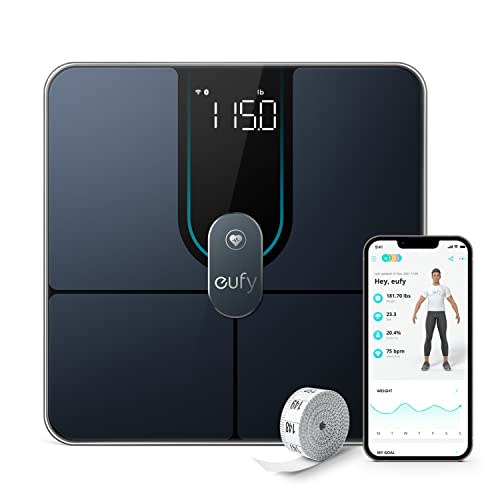
eufy Smart Scale P2 Pro (T9149)eufy Smart Scale P2 Pro (T9149)A published 50 g weight accuracy for less, and a maker that calls its own body fat figure an approximation. Full review
-
Best without an app
Tanita BC-533 InnerScan Body Composition MonitorTanita BC-533 InnerScan Body Composition MonitorThe only pick named in an FDA clearance, with readings on the scale and no phone needed. Full review


All three are sold in both the US and the UK.
What a smart scale gets right: your weight
Weight is the easy part. A scale has load sensors under the platform, and a decent one measures how hard you press on them very precisely. When researchers at a Paris hospital weighed patients on three consumer smart scales straight after a DEXA scan (the hospital reference method for body composition), the median weight error was 0.3 kg, 0 kg and 0.25 kg for the three scales. For tracking your weight from week to week, that is plenty.
What spoils a weight reading is usually the setup, not the scale. eufy’s own advice is typical: wait for the scale to show zero before you step on, stand still until it finishes, and wait for it to switch off before you move it. A hard, level floor matters too. Weigh yourself at the same time of day, in similar clothing, and your trend will mean something.
Accuracy is not the same as increments
Almost every smart scale on Amazon says it measures in steps of 0.1 or 0.2 lb. That is the display’s resolution: the smallest change it can show. It says nothing about whether the number is right. A scale can show 0.1 lb steps and still read 2 lb heavy. That is why we only list scales whose maker states an accuracy figure, such as Withings’ “accurate to within 50g”, or whose model has been through FDA review.
What it estimates: body fat, muscle and “metabolic age”
Smart scales with metal pads on the platform use bioelectrical impedance analysis (BIA). The scale sends a small current up one leg and down the other, measures how much the body resists it, and plugs that number, plus the height, age and sex you entered, into the maker’s own equations. A review by the ESPEN working group on BIA explains that this can estimate fat-free mass and body water in people without significant fluid or electrolyte problems, but only when the equations suit the person being measured, and that the method “suffers from a lack of standardized method and quality control procedures.”
The independent studies show what that means in practice:
- The Paris study found median fat mass errors of 2.2, 4.4 and 3.7 kg across the three scales, with wide ranges either side. The authors concluded that smart scales “are not accurate for body composition and should not replace DEXA in patient care.”
- A 2023 study of fifteen BIA devices, fourteen of them consumer models, compared each with a laboratory four-compartment model. The average body fat error ranged from 3.5 percentage points too low to 11.7 points too high, depending on the device. But the devices were very repeatable, and the authors found some of them, particularly models with hand and foot electrodes and a few foot-to-foot scales, may be useful for tracking changes over time.
- A 2008 German study compared consumer devices with MRI and DXA. Every foot-to-foot device showed a systematic bias for body fat, with individual readings that could fall anywhere from 14.5 percentage points too low to 8.6 too high. The authors recommended devices that use hand and foot electrodes for individual use.
“Metabolic age” sits on top of those estimates. It is a figure each maker calculates its own way, and none of the health bodies we cite uses it.
What to do with the body fat number
Take the trend more seriously than the figure. The 2023 study suggests a consumer scale is better at telling you that your body fat is going up or down than at telling you what it is. Weigh in the same conditions each time, and look at months, not days.
If you want a health measure beyond weight, the NHS points to two that need no electronics at all. Your BMI, worked out from your height and weight, is its first check, though it notes BMI “cannot tell the difference between muscle and fat.” Your waist size is the second: the NHS advises keeping it to less than half your height.
Why so few smart scales are “FDA cleared”
In the US, a body composition analyzer is a Class II medical device, and the FDA’s classification for it requires a 510(k) clearance before it is sold for a medical purpose. The FDA database lists few consumer scales under that device type, and most of those clearances are more than a decade old. One of those scales is still widely sold: Tanita’s BC-533, which is named in a 2004 clearance. The FDA summary for that clearance describes it as a device that “determines body weight and estimates body fat,” which is exactly the right way to think about every scale on this page.
If you have a pacemaker
The current a BIA scale sends through your body is tiny, but scale makers say it should not be used with a pacemaker or other implanted electronic device. Withings’ safety guidance, for example, says plainly that people with a pacemaker should not use the body composition measurements. Every pick below can still weigh you: Withings’ app and the Tanita have a weight-only mode, and eufy only takes body composition readings with bare feet. Check your scale’s manual before you use it, and ask your doctor if you are unsure.
The picks
Withings Body Smart Wi-Fi Scale (WBS13)
A Wi-Fi and Bluetooth bathroom scale that Withings says holds weight accuracy to within 50 g (about 0.1 lb). It recognizes up to 8 people by their weight, sends each weigh-in to the Withings app, and adds body fat, muscle and water estimates from bioimpedance.
- Model
- WBS13
- Weight accuracy
- Within 50 g, per Withings
- Users
- Up to 8, recognized automatically
- Connectivity
- Wi-Fi and Bluetooth, Withings app
- Battery
- Over 15 months, per Withings
- Extras
- Pregnancy mode and baby mode
The proof: Withings: Body Smart specifications
Best for
A household that wants a precise weight log that fills itself in, without carrying a phone to the bathroom.
Worth knowing
The body composition figures are estimates, like those of every bioimpedance scale. Withings says people with a pacemaker or other implanted device should not use those features; the app has a weight-only mode.
Withings states that the Body Smart holds weight accuracy to within 50 g, and it sends every weigh-in to your phone over Wi-Fi, so your log builds itself without the phone in the room. It recognizes up to 8 people from their weight, and has pregnancy and baby modes. Withings has more independent research behind it than most brands: an earlier Withings scale, the Body Cardio, was one of the three in the Paris study, where its weight readings were close to the hospital’s. That study was not of this model, and it found the body fat figures far less reliable than the weight.
eufy Smart Scale P2 Pro (T9149)
A Wi-Fi and Bluetooth scale that eufy rates at 50 g (0.1 lb) accuracy, with a weighing range of 0.1 to 180 kg. It shows weight, body fat and heart rate on the scale and the rest in the EufyLife app. eufy itself describes the body fat figure as "an approximation".
- Model
- T9149
- Weight accuracy
- 50 g / 0.1 lb, per eufy
- Range
- 0.1 to 180 kg (0.2 to 397 lb)
- Connectivity
- Wi-Fi and Bluetooth, EufyLife app
- Water resistance
- IPX5, per eufy
- Power
- 4 AAA batteries
The proof: eufy: Smart Scale P2 Pro specifications
Best for
A lower-cost smart scale with a published accuracy figure, for anyone tracking weight over weeks and months.
Worth knowing
Ignore the 16-measurement headline: everything beyond weight is a bioimpedance estimate. You need bare feet for those readings, and the scale only switches on above 3 kg.
The P2 Pro is a lower-cost way to get a published accuracy figure: eufy rates it at 50 g (0.1 lb), with a range up to 180 kg. Its listing advertises 16 measurements, but its own FAQ is refreshingly frank that the body fat percentage “is an approximation.” Buy it as an accurate scale with a free app, and treat the extra numbers as the estimates eufy says they are.
Tanita BC-533 InnerScan Body Composition Monitor
A glass bathroom scale from Tanita, a Japanese maker of professional body composition analyzers. The BC-533 is named in an FDA 510(k) clearance as a body composition analyzer: the FDA summary describes it as a device that "determines body weight and estimates body fat". No app, no Wi-Fi; four user memories and readings on the scale itself.
- Model
- BC-533
- Weight
- 0.2 lb accuracy, up to 330 lb, per the Tanita listing
- Users
- 4 memories, plus guest and weight-only modes
- Estimates
- Body fat, body water, muscle, bone, visceral fat rating
- Power
- 4 AA batteries, included
The proof: FDA 510(k) K040778
Best for
Anyone who wants the one scale here that went through FDA review, and does not want an app.
Worth knowing
FDA clearance means the FDA accepted it as equivalent to an earlier cleared device. It does not make the body fat number exact, and the clearance itself calls it an estimate. Readings stay on the scale; keep your own log.
The BC-533 is the only scale here that went through FDA review, and the one to choose if you would rather not put another app on your phone. It shows its readings on the platform, keeps four users’ settings, and has a weight-only mode. FDA clearance is a review against an earlier device, not proof that its body fat reading is right for you; the FDA summary itself calls the body fat figure an estimate. The BC-532, a sister model in the same InnerScan range, was one of the devices in the 2008 German study, where it showed the same foot-to-foot bias as the others.
What did not make the list
Several popular scales are missing on purpose:
- Most bestselling Bluetooth scales, including well-rated models from RENPHO and Etekcity. Their listings give a display increment of 0.1 or 0.2 lb, but we could not find a stated weight accuracy from the maker, so they do not pass our bar yet.
- Withings Body Scan. Its built-in ECG is FDA cleared (as the Withings Scan Monitor 2.0) to detect signs of atrial fibrillation, but buyers rated it well below our bar on Amazon in both countries when we checked.
- Withings Body Comp. Also below our rating bar on amazon.com.
- Omron BF511. A hand and foot scale, the design the 2008 study preferred, and well rated in both countries. We could not open Omron’s specification pages to confirm a published accuracy figure for this model, so it is left out until we can.
A good smart scale will tell you your weight to within a few hundred grams, every morning, for years. That is genuinely useful. The body fat, muscle and metabolic age figures are best read as a rough trend, and if you need an accurate body composition measurement for a medical reason, ask your doctor about a clinical test rather than relying on a bathroom scale.